
Tree growth rates in southern African woodlands and savannas
Tree growth rates are important when designing sustainable harvesting cycles, carbon sequestration projects, and modelling woody ecosystem dynamics. In African ecosystems, tree growth rates and their determinants are not well understood, even though these ecosystems are utilised by local people for woodland resources, for wood fuel and timber. Further, these ecosystems have also been targeted for carbon offset projects aiming to maximise woody biomass production to slow the increase of atmospheric CO2 concentrations. As part of the FEFA research program, I have been working to understand tree growth rates and their determinants across the woodlands and savannas of southern Africa. In this study, I zeroed in on Zimbabwe’s Teak Woodlands to explore tree growth rates and their determinants, using the long-term monitoring data collected by the Zimbabwe Forestry Commission, stored and managed by the Socio-Ecological Study for the Study of African Woodlands (SEOSAW).
Overview
Zimbabwe has more than 800 000 ha of protected indigenous Teak woodlands in the north-western parts of the country. The woodlands are dominated by Zambezi teak (Baikiaea plurijuga) occurring in association with Bloodwood (Pterocarpus angolensis), Mountain mahogany (Entandrophragma caudatum), African rosewood (Guibourtia coleosperma) and Zebra wood (Brachystegia spiciformis). The woodlands are valuable for timber and are key for protection of the watershed that feed into the Zambezi River. The analysis used tree measurements data from eleven permanent sample plots that tracked 2,466 tree stems across 33 woodland species. The findings showed that over 27 years, growth increased with water availability and atmospheric CO2, while competition strongly constrained growth. Doubling stand basal area nearly doubled the estimated time for trees to reach harvestable size from about 150 to 292 years. These findings provide practical evidence for aligning harvesting cycles, management interventions, and long-term monitoring with the ecological dynamics of woodlands.
Most tree species exhibit low annual growth rates
The predicted median growth rate of a species growing in a plot with a median basal area of 11 m2 ha−1 was 0.8 mm per year, with species mean growth rates ranging from 0.2 mm to 2.6 mm per year. The time for key timber species to reach a harvestable size (35 cm in diameter) was, on average, 149 years for G. coleosperma, 189 years for B. plurijuga, and 114 years for P. angolensis. Even the fastest-growing individual stems of timber species (the 90th percentile) took 121 years to reach harvestable size. woodlands have targeted a few species and there has not been a complete coverage
Growth rates varied substantially among species and between individual trees, with species mean growth rates ranging from 0.2 to 2.6 mm per year.
Some important timber species grew faster than the predicted median, including G. coleosperma at 1.2 mm per year and B. plurijuga at 0.9 mm per year. Growth trajectories also differed with age and size: B. plurijuga grew faster as it aged, G. coleosperma slowed over time, and P. angolensis maintained a constant rate as stem size increased. Several species commonly used by communities for fuelwood and poles grew more slowly Combretum collinum at 0.7 mm per year, Colophospermum mopane at 0.6 mm, and Terminalia sericea at 0.5 mm. However, because their harvestable sizes are smaller (for example, 4–10 cm for fuelwood), their production cycles and appropriate harvesting intervals differ from those of timber species.
Higher plot-level basal area, a proxy indicator for tree-tree competition, was associated with lower growth rates
Competition effects were particularly pronounced where basal area exceeded approximately 18 m2 ha−1. For B. plurijuga, doubling the basal area from 11 m2 ha−1 to 22 m2 ha−1 increased the estimated time to harvestable size from 189 to 419 years. This highlights the strong influence of tree-to-tree competition on woodland productivity and recovery overtime. It points to the potential of intermediate thinning and selective harvesting to ease competition within stands and increase growth rates.
Tree growth rates increased during periods with higher water availability and at higher atmospheric CO2 concentrations
Although annual rainfall and temperature did not increase significantly within the study area, there were large variations between census intervals due to extreme drought and flooding events. This matters for long-term planning because woodland productivity is not fixed but shifts with environmental conditions, making sustained monitoring essential for tracking trends across variable climates.
Conclusion
The findings of this study improve our understanding of how woodland systems may respond to environmental change and contribute to ongoing efforts to support sustainable woodland management, restoration, and long-term ecological stewardship across African landscapes. To enhance availability of the findings of this study for policy makers we have made the attached policy brief. In the next steps of this study will seek to generate the first and most extensive tree growth rates dataset for the most common species in southern African woodlands and savannas, which will be publicly available in a repository and through a web application.
Download the PDF document here:
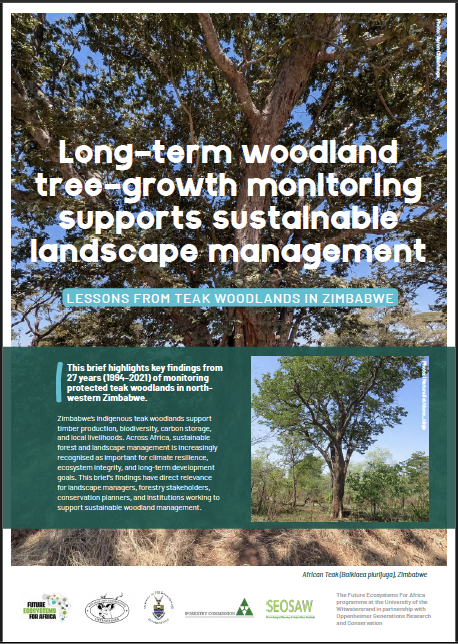 Long-term woodland tree-growth monitoring supports sustainable landscape management – Lessons from Teak Woodlands in Zimbabwe.
This brief highlights key findings from 27 years (1994-2021) of monitoring protected teak woodlands in northwestern Zimbabwe.

Download the poster here
Author Bio – Tatenda Gotore
Tatenda is a Forest Ecology and Management Researcher focusing on tree growth rates and sustainable harvesting in woodlands of southern Africa. His research uses a long-term network of tree plot data from SEOSAW Partnership to understand tree growth rates and inform sustainable utilisation of the miombo woodlands. His research interests include exploring relationships between biomass accumulation and disturbance (human, fire, elephant) in miombo woodlands and its influence on biomass change, to optimise utilisation but also in view of biodiversity conservation and climate change. Tatenda is also a steering committee member of the Miombo Network and a Certified Reviewer for national GHG inventories with UNFCCC.
Related Posts
African Dendrochonological Field School
Gotore, T. et al. (2026). Tree Growth Rates and Their Determinants Inform Sustainable Harvesting of Indigenous Woodlands in Zimbabwe. Biotropica 58.
Tatenda Gotore
SEOSAW Researcher / PhD Candidate
School of Animal, Plant and Environmental Sciences, University of Witwatersrand
Email: tatenda.gotore@wits.ac.za
LinkedIn: Tatenda Gotore