Finding Pathways for People and Nature to Thrive Together in Africa
Across Africa, millions of people live within and alongside nature. Healthy ecosystems support livelihoods, food security, water resources, cultural values and economic opportunities. As countries pursue development goals and respond to climate change, the challenge is not simply to protect nature, but to find ways for people and nature to thrive together.
The Africa’s Nature Transition: A Roadmap for People, Nature and Climate brings together leading African researchers and practitioners to explore how this can be achieved. Drawing on African expertise, locally relevant data and future-focused scenario planning, the Roadmap identifies pathways for protecting, managing and restoring ecosystems while supporting sustainable development and human wellbeing.
The report shows that Africa’s forests, grasslands, wetlands and coastal ecosystems could contribute up to 1.6 gigatons of carbon mitigation annually between 2026 and 2050. Yet its central message extends beyond climate mitigation: natural climate solutions must be designed in ways that work for the people who depend on these landscapes every day.
Guided by the Six Principles to Get Natural Climate Solutions Right in Africa, the Roadmap provides evidence and practical guidance for governments, communities, investors and development partners. It demonstrates how nature-positive development can strengthen resilience, create economic opportunities, support biodiversity and improve quality of life across the continent.
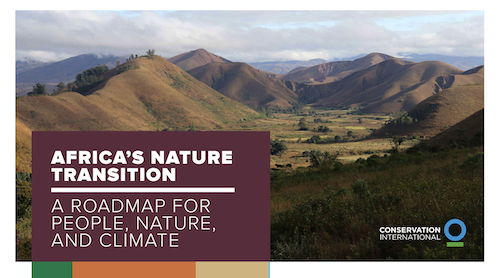 Africa’s Nature Transition: A Roadmap for People, Nature and Climate.

“For too long, global climate policy and finance have treated Africa as an afterthought. This roadmap seeks to change that,” said Conservation International’s Chief Field Officer in Africa, Jimmiel Mandima. “It’s an African-led initiative that says economic growth doesn’t have to come at a high carbon cost — we can drive climate action while also lifting people out of poverty.”
“The Roadmap provides practical and inclusive pathways for nature-based climate action”, said Laura Pereira, co-PI of the Future Ecosystems for Africa Program at Wits University, who co-authored the report. “We aim to inspire novel approaches to natural climate solutions globally by defining best practices”.
The report’s top solutions for carbon mitigation include:
- Sustainable management of livestock and fire: Smarter grazing and fire management across Africa’s vast rangelands could sequester up to 11Gt of carbon dioxide equivalents by 2050, while increasing livestock productivity and protecting biodiversity.
- Reforestation and freshwater ecosystem restoration: Restoring degraded forests, wetlands and watersheds through natural regeneration, assisted planting and sustainable water management could capture up to 8Gt of carbon dioxide equivalents by 2050, while improving water quality, reducing flood and drought risks, and supporting rural livelihoods.
- The report fills an urgent gap by developing new methods for restoring ecologically-appropriate levels of tree cover in savannas and woodlands: areas previously subject to inappropriate afforestation targets. While maximizing tree cover is not the goal in these landscapes, they also have carbon sequestration potential of ~2Gt by 2050 because restoring grassy ecosystems can increase soil carbon stocks.
- Climate-smart farming and cultivation: By scaling regenerative and agroforestry practices across just half of Africa’s smallholder farms, the continent could prevent 6.5 Gt of carbon dioxide equivalents by 2050 while boosting yields, improving soil health and creating millions of new agricultural jobs.
A call for investment and partnership
The roadmap calls for coordinated action across sectors, urging governments to embed nature targets into national climate plans while encouraging financial institutions to expand green investment and close persistent climate finance gaps.
Ultimately, the report argues that advancing natural climate solutions in Africa is not only a regional priority, but a global necessity.
“Climate change is accelerating and the window for action through adaptation is closing,” said Perushan Rajah, who leads Conservation International’s nature-based solutions in Africa and co-authored the report. “This report shows that Africa is central to the global solution. Investing in nature now can help chart a unique path forward that allows people and nature to co-exist in harmony.”
As part of this growing body of work, partners involved in the roadmap are also developing the Landscape Decision Dashboard (LDD), a new decision-support tool designed to help landowners, communities, researchers and policymakers explore how different land management choices may affect ecosystems over time.
By combining real-world environmental data with ecosystem response models, the LDD aims to make science more accessible and actionable for on-the-ground decision-making across Africa. More information on the platform and future developments will be announced in the coming months.