
African Dendrochronological Field School
Introduction
Dendrochronology is the scientific method of dating and studying past events using annual growth rings of trees. It has been established that some trees grow one ring per year, and the width, density and structure of the rings reflect environmental conditions (rainfall, temperature, drought and fire) in that year. The African Dendrochronological Field School (ADF) has been held in Zambia every year since 2024 with the aim of imparting basic scientific knowledge to participants on the techniques and application of tree-ring science to understand and solve various environmental problems affecting trees and the forests. I had the opportunity to take part in the ADF 2025, held from 16 – 26 July 2025 in the resort town of Livingstone, Zambia, thanks to the financial support by the Association for Tree-ring Research and the Future Ecosystems for Africa (FEFA) project at the University of Witwatersrand.
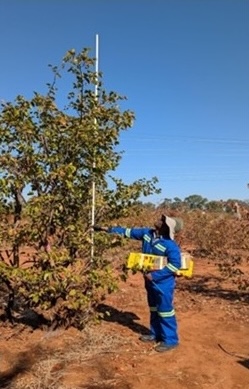
Overview
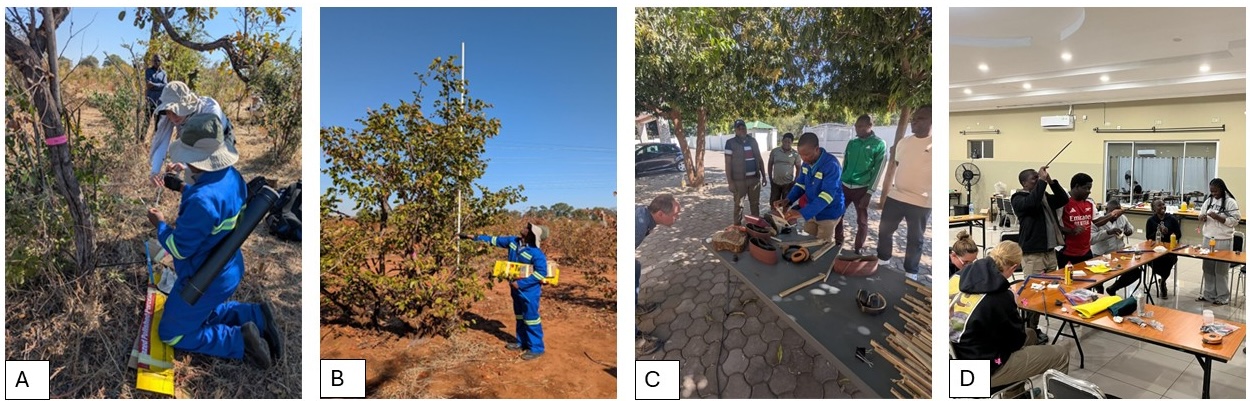
The course was designed for students, researchers, and professionals in fields such as ecology, climatology, archaeology, and environmental science. It aimed to equip participants with both theoretical knowledge and practical skills for analysing tree-ring data focusing on climate, ecology and wood anatomy. The field school combined lectures, fieldwork, lab sessions, and excursions to train participants in dendrochronology. Introductory lectures covered key principles, applications, and tools, while fieldwork focused on either dendroecology (elephant disturbance in mopane woodland) or dendroclimatology (climate–growth responses in savannah species). Participants collected and processed tree samples, applying standardized lab techniques and software for crossdating, quality checks, and climate analysis, with each component strategically organized to build a foundational understanding and hands-on proficiency in dendrochronology. In the latter part of the course, we worked with different software including COFECHA, ARSTAN, CDendro, Coorecorder, and R to analyze and interpret the tree-ring data. We learned to crossdate tree-ring data, build chronologies, and analyze results. The program concluded with group presentations and cultural excursions, including visits to Mukuni village and Victoria falls. The main focus of my participation was to gain basic dendrochronology skills that would enable me to collect, process samples and analyse data to sufficiently be able to answer my research questions pertaining to the differences in tree growth estimates between tree ring studies and biometry studies.
Methods of assessing tree growth rates
Biometry and tree ring studies are the most common ways of obtaining tree growth rates. Biometry involves long term observations tree growth in permanent plots over time. However long-term permanent plots are associated with high costs for establishment, monitoring and maintenance over long periods of time, though the provide the most accurate field data of tree measurements. Tree ring studies provide an easier method to obtain long term data through a single data collection campaign. However, these studies depend on trees formulating rings that be readable and not all species produce these readable rings. For this reason, studies in southern African woodlands have targeted a few species and there has not been a complete coverage
Differences in tree growth rates estimates from biometry and tree ring studies
Estimates of tree growth rates from tree ring and biometry studies are worryingly different and consistently show that dendrochronology estimates are about double the PSPs estimates. There are currently no studies that have tried to explore these differences, though some studies in other regions have used both methods to complement each other. The difference could be due to measurements being focused on different sized/aged trees (easier to do dendrochronology in younger trees), or to differential survival of fast-growing individuals, but remains to be further explored. Such a study can help to establish the utility of biometry and tree ring based tree growth studies as complements in providing accurate estimates and possibly reduce uncertainties associated with the current understanding of tree growth in southern African savannas and woodlands.
Key findings
- Indigenous knowledge and the associated threats in mangrove conservation practices in the MTBR are documented for the first time in Benin Republic and Togo.
- The contribution of indigenous practices in solving the Food-Climate-Biodiversity nexus in the MTBR is recorded.
- Map of the different indigenous led initiatives that are driving positive social and environmental change in the MTBR.
- Scenarios of the use of ILK in the desirable futures for the relationship between IPLCs and the MTBR Pathways.
Conclusion
This work, among other things seek to generate the first and most extensive tree growth rates dataset for the most common species in southern African woodlands and savannas. In the process I will apply the skills obtained from the ADF 2025 to explore the differences between biometry and tree ring studies and establish if these two methods can complement each other in providing more accurate estimates of tree growth rates. Accurate tree growth information is required to inform sustainable harvesting cycles, the validation and verification of carbon sequestration projects, and the development of models aimed at advancing understanding of woody ecosystem dynamics.
Author Bio
Tatenda is a Forest Ecology and Management Researcher focusing on tree growth rates and sustainable harvesting in woodlands of southern Africa. His research uses a long-term network of tree plot data from SEOSAW Partnership to understand tree growth rates and inform sustainable utilisation of the miombo woodlands. His research interests include exploring relationships between biomass accumulation and disturbance (human, fire, elephant) in miombo woodlands and its influence on biomass change, to optimise utilisation but also in view of biodiversity conservation and climate change. Tatenda is also a steering committee member of the Miombo Network and a Certified Reviewer for national GHG inventories with UNFCCC.
Tatenda Gotore
SEOSAW Researcher / PhD Candidate
School of Animal, Plant and Environmental Sciences, University of Witwatersrand
Email: tatenda.gotore@wits.ac.za
LinkedIn: Tatenda Gotore